Shakespeare's language sounds a little weird at first. But really, once you try to read those "fancy" words and funky word order, the story isn't that difficult to get. Check out this awesome example by comedian John Branyan: A Triune Tale of Diminutive Swine (recorded live show video here).
Shakespeare's language sounds funny because it is Early Modern English, not our Modern English that we speak every day. You see, our language has morphed from Germanic roots of Old English to the Latin influence of Middle English and additions of French during the Renaissance to create Early Modern English. Now this all happened through a series of mini, simple changes to the everyday language (known as vernacular) that later became a significant shift in how the language was spoken and written. Etymology and linguistics is supremely interesting, so be sure to check out some resources if it intrigues you to know why we spell some words "ie" and others "ei" (or "ph" and "f").

Showing posts with label How to Read a Text. Show all posts
Showing posts with label How to Read a Text. Show all posts
Monday, April 20, 2015

Tuesday, August 26, 2014
Analyze the Rhetoric!
Now that you have taken the terms and identification portion of the test, you will now analyze the SOAPS of a recent persuasive speech: President Barack Obama's 2012 Inaugural Address. Feel free to listen to his speech tonight so you can hear and see the inflection and emphasis he puts on certain words. Tomorrow, you will just have an abbreviated transcript to work with in order to label and clarify the SOAPS of his rhetorical strategy. Short and sweet Inaugural Address--PERFECT for analysis!
Monday, August 25, 2014
Identifying Thesis and Supporting Claims
Today, we looked at a hilarious, but well-structured "This I Believe" Essay. Even though Elizabeth talks about Rice Krispies as heroes, this essay is a GREAT example of what I am looking for in your personal reflective essays. Be sure that you are elaborating like she does about each of your examples and character traits.
 Check out these articles about Real-Life Heroes from CNN. These articles are much more thorough, detailed, and researched but still offer insight into writing your own personal essay. See if you can identify the theses and main supporting claims in the articles!
Friday, August 15, 2014
The Hero's Journey: Archetypes and Characters
Yesterday, we talked all about the plot side of the Hero's Journey. Now, it's on to character archetypes.
From the Storybuilder User's Manual, "an archetype is a prototype or model from which something is based. A significant character's role can often be associated with one of these archetypes."
For the main archetypes, check out this explanation video from the awesome YouTube Channel of Gloves and Boots:
Check out this website that describes each of the main archetypes.
For a more detailed list of archetypal characters, situations, and conflicts, check out this resource.
Here is a fun chart from The Boston Globe that illustrates some character archetypes in popular films.

From the Storybuilder User's Manual, "an archetype is a prototype or model from which something is based. A significant character's role can often be associated with one of these archetypes."
For the main archetypes, check out this explanation video from the awesome YouTube Channel of Gloves and Boots:
For a more detailed list of archetypal characters, situations, and conflicts, check out this resource.
Here is a fun chart from The Boston Globe that illustrates some character archetypes in popular films.
Tuesday, August 12, 2014
The Hero's Journey
All of us are used to the tired, boring mountain of a plot diagram. The following should look all too familiar:

It's time to UPGRADE that basic plot diagram. Joseph Campbell wrote The Hero with a Thousand Faces in 1949 after appearing on PBS with compelling lectures of the same topic: ALL stories follow the basic plot line with similar characters and events. He went on to label these steps and archetypal characters to create what we now refer to as "The Hero's Journey."
Chris Vogle summarizes Campbell's theory in this paragraph: "Campbell is a mythographer -- he writes about myths. What he discovered in his study of world myths is that THEY ARE ALL BASICALLY THE SAME STORY -- retold endlessly in infinite variation. He discovered that all story-telling, consciously or not, follows the ancient patterns of myth, and that all stories, from the crudest jokes to the highest flights of literature, can be understood in terms of the 'HERO MYTH;' the 'MONOMYTH' whose principles he lays out in the book."
Here is a detailed look at Campbell's Hero's Journey.

And now, let's apply Campbell's terminology to an inverted plot diagram. (Initiation=Rising Action; The Pit=Climax; etc).
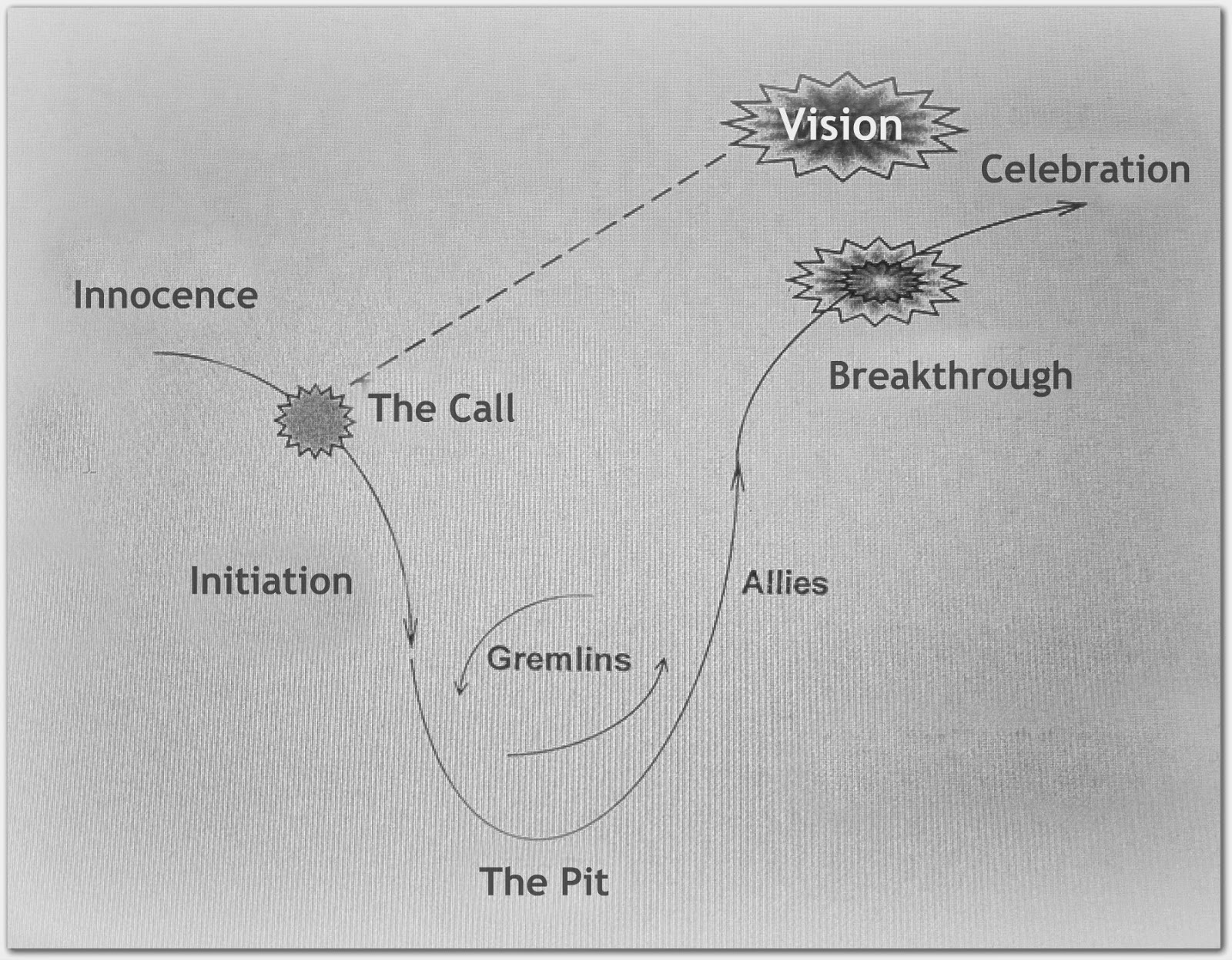
We are going to identify these steps in various fiction literature, so keep this chart handy. There are also TONS of resources about the Hero's Journey on the interwebs, so be sure to search Google, Pinterest, Hollywood news, and plenty of college websites to learn and explore more!
Check out the following lesson, "The Hero's Journey: Archetypes and Characters!"
It's time to UPGRADE that basic plot diagram. Joseph Campbell wrote The Hero with a Thousand Faces in 1949 after appearing on PBS with compelling lectures of the same topic: ALL stories follow the basic plot line with similar characters and events. He went on to label these steps and archetypal characters to create what we now refer to as "The Hero's Journey."
Chris Vogle summarizes Campbell's theory in this paragraph: "Campbell is a mythographer -- he writes about myths. What he discovered in his study of world myths is that THEY ARE ALL BASICALLY THE SAME STORY -- retold endlessly in infinite variation. He discovered that all story-telling, consciously or not, follows the ancient patterns of myth, and that all stories, from the crudest jokes to the highest flights of literature, can be understood in terms of the 'HERO MYTH;' the 'MONOMYTH' whose principles he lays out in the book."
Here is a detailed look at Campbell's Hero's Journey.
And now, let's apply Campbell's terminology to an inverted plot diagram. (Initiation=Rising Action; The Pit=Climax; etc).
We are going to identify these steps in various fiction literature, so keep this chart handy. There are also TONS of resources about the Hero's Journey on the interwebs, so be sure to search Google, Pinterest, Hollywood news, and plenty of college websites to learn and explore more!
Check out the following lesson, "The Hero's Journey: Archetypes and Characters!"
Friday, August 8, 2014
55-Fiction: Quality Stories
I asked you to give me what characteristics must be present for a story to be a story. You seemed to boil down the qualifications to four main things: characters, setting, plot, and meaning. After establishing these qualifications, I shocked you with 55-Fiction!

So with these "Shortest Stories" we have completed a rotation of Independent Reading so that I can answer your questions and guide you through the process with a short, easy text before you launch into reading full short stories, novels, or other texts.
Be thinking of novels, stories, or other texts that you have always wanted to read!
Subscribe to:
Posts (Atom)